
The main function of the peripheral zone (also called edge lift) is to accommodate a tear reservoir for a healthy and comfortable fit. Your aim is to allow an adequate amount of edge lift to keep the lens comfortable on the eye.
Important to note that fluorescein peripheral patterns have an opposite appearance to the central patterns. With peripheral patterns, dark/too thin edge is too steep (digging into the cornea) and light green/thick edge is flat (edge lifting off the cornea).
The InnoCon range of lens designs are carefully calculated that the back optic zone radius (Central Zone) closely correlates to a correct peripheral edge lift (60µm) for that design. So if the edge lift is severely incorrect- the wrong lens design was chosen when the fit started.
Alignment Fit for Peripheral Zone #
Evaluating the edge clearance/ peripheral zone with fluorescein, the edge clearance ideally should be 60-80 µm. Fluorescence is visible at 60µm, so a lack of a bright ring of fluorescein indicates insufficient clearance. The ideal width of the ring should be 0.4 to 0.5mm.1

Steep Edge Lift/Peripheral Zone #
A dark and very thin ring indicates the edge is too steep for the peripheral cornea. The edge is digging into the area.
A steep edge lift/peripheral zone is most likely due to a lens design with not enough lens curves (eg. TriCon), so a lens design with more curves (eg. MultiCon) should be used to flatten the edge lift/peripheral zone and will result in better alignment, providing that your Central Zone (Back Optic Zone Radius) is accurate. Small edge adjustment from steep to flatter edge can be done in the lab.

Objective findings like Central Pool with Ring Touch inside Bevel or “H” Pattern also supports the steep edge fluorescein findings.
Initial feedback would be that the fit is very comfortable, as there is no lid interaction, but in the long run the subjective feedback might change to complaints of a Deep Ache, Cutting Pain, Burning (Hotness), Excessive Lacrimation, Lid Edema or Difficulty Looking Up, Reduced Acuity (Initial or Late Day), Reading or Fluctuating Blur, Late Day Fogging or Hazing, Halo’s and Fogging that will support the steep edge fluorescein findings.
Flat Edge Lift/Peripheral Zone #
A bright and very wide ring indicates the edge is too flat for the peripheral cornea. The edge is “lifting off” the area. A very thick tear film is present.1
A flat edge lift/peripheral zone is most likely due to a lens design with too many lens curves (eg. MultiCon), so a lens design with less curves (eg. TetraCon/TriCon) should be used to steepen the edge lift/peripheral zone and will result in better alignment, providing that your Central Zone (Back Optic Zone Radius) is accurate. A flat edge can not be steepen in the lab.
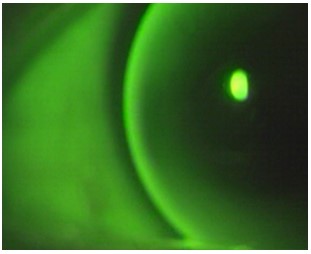
Objective findings like 3 & 9 o’clock Staining, “H” Pattern or Excessive Edge Stand-off also supports the flat edge fluorescein findings. The eye may also start producing more mucous- acting as a grease to try and get rid of the “foreign body” constantly agitating the lids. The mucous will attach to the lens edge and over time the patient will have dirty, non-wetting areas on the lens edge.
Subjective feedback like Reduced Acuity (Initial or Late Day), Reading or Fluctuating Blur, Distortion or Photophobia also supports the flat edge fluorescein findings.
1. Hom MM and Bruce AS. Manual of contact lens prescribing and fitting, Third Edition. 2006:175


